Marriage Certificate in India: 7 Steps Every Couple Should Know
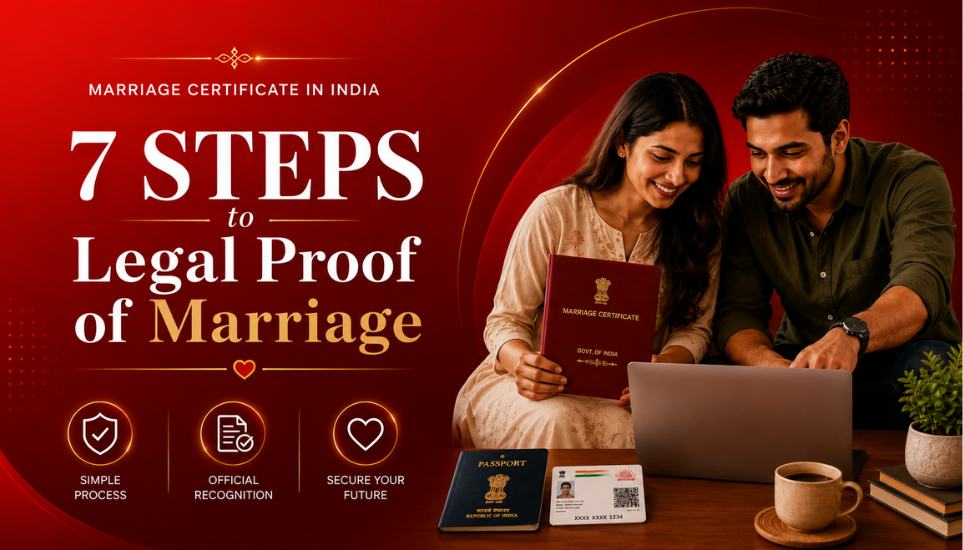
In India, a wedding is rarely just a legal event. It is a vibrant blend of rituals, emotions, family gatherings, and traditions that span multiple days. Between the pheras, the vidaai, and the non-stop celebration, one quiet but crucial responsibility often gets forgotten: the marriage certificate.
While your families now see you as a married couple, the Indian government still needs official proof. Whether you are applying for a joint bank account, updating your passport, or planning an international honeymoon, understanding the marriage registration process in India is essential for a stress-free married life.
This guide breaks down everything you need to know about obtaining your marriage certificate-without the confusing legal jargon.
What is a Marriage Certificate in India?
Simply put, a marriage certificate is a legal document issued by the Indian government that serves as official proof that two individuals are married. It validates your union under the law, giving you rights and responsibilities as a married couple.
Many couples mistakenly believe that the wedding invitation or the saat phere video is enough. But legally, without this document, your marital status may not be recognized by banks, courts, or immigration departments. A marriage certificate is the single most reliable legal proof of marriage in India.
Why Marriage Registration Matters (Beyond the Paper)
Imagine this: You and your partner have been married for six months. You finally find the perfect rental apartment in Mumbai. The landlord asks for a marriage certificate to add both names to the lease. You don’t have one. Suddenly, a simple task becomes complicated.
Or consider applying for a spouse visa for Canada or Australia. The first document on the checklist is always your official marriage certificate.
Beyond logistics, registering your union protects both partners in medical emergencies, insurance claims, and legal matters. The marriage registration process in India is not just paperwork-it is your first act of responsible partnership.
The Difference Between a Wedding Ceremony and Legal Registration
This confuses many modern Indian couples. Your religious wedding (Hindu, Sikh, Christian, Muslim, or interfaith court marriage) is a sacred or social ceremony. The marriage certificate is a state-recognized legal contract.
- Wedding ceremony: Emotional, social, and religious.
- Marriage registration: Legal, administrative, and protective.
You can have a grand destination wedding in Udaipur, but until you visit the Sub-Registrar’s office or apply online, the government does not officially recognize your marriage. Both are important, but only one gives you legal proof of marriage in India.
Marriage Registration Process in India Explained Simply
The how to apply for marriage certificate question has two main legal paths depending on your religion and personal preferences. Here is a simple breakdown.
1. Registration Under the Hindu Marriage Act, 1955
This applies to Hindus, Jains, Sikhs, and Buddhists. If your wedding followed traditional rituals, you usually register under this Act. One major requirement: a priest’s certificate or proof of the ceremony.
2. Registration Under the Special Marriage Act, 1954
This is ideal for interfaith or intercaste couples, or anyone who prefers a civil marriage not tied to religious rituals. You do not need a religious ceremony. You give a 30-day public notice, and if no one objects, the marriage is registered. Many urban Indian couples prefer this for its neutrality.
State-Wise Variations
While the central laws are the same, the marriage registration process in India can vary slightly across states. For example:
- Delhi: Fully online appointment system at SDM offices.
- Maharashtra: Often requires a physical visit to the Sub-Registrar office in your jurisdiction.
- Tamil Nadu & Karnataka: Strong preference for online applications via state portals.
Always check your state’s specific portal before starting.
Documents Required for Marriage Certificate
Gathering the right paperwork early saves weeks of delays. Below is the standard list of marriage certificate documents required for most Indian couples.
For All Couples (Originals + Self-Attested Copies)
- Application form (signed by both spouses)
- Proof of age (Birth certificate, 10th mark sheet, or passport)
- Proof of address (Aadhaar card, voter ID, driving license, or utility bill)
- Passport-size photographs (4–6 copies of each spouse)
- Wedding invitation card (if available)
- Affidavit from both partners stating marital status and date of marriage
- Photograph of the wedding ceremony (for Hindu Marriage Act cases)
In Case of Court Marriage or Special Marriage Act
- Gazette notification (in some states)
- Residence proof for 30 days before notice period
Witness Requirements
You need three witnesses for Hindu Marriage registration and two for the Special Marriage Act. Witnesses must carry their own Aadhaar card, PAN card, or passport.
Pro tip: Keep at least 5–6 extra copies of each document. Indian government offices often ask for additional self-attested duplicates.
How to Apply for Marriage Certificate: Online vs Offline
Indian couples today have two clear paths to get their marriage certificate.
Online Marriage Certificate India (Recommended for most)
Most states now offer an online marriage certificate India portal. Here is the general process:
- Visit your state’s e-District or marriage registration website.
- Fill out the joint application form (both partners’ details).
- Upload scanned copies of marriage certificate documents required.
- Book an appointment at the local SDM or Sub-Registrar office.
- Visit the office on the scheduled date with originals for verification.
- Certificate is issued within 7–15 working days (sometimes same-day in urban centres).
Offline Application Process
You can directly visit the Sub-Registrar office in your jurisdiction. However, most offices now encourage online marriage certificate India applications first. Offline is slower and may require more visits.
Common Mistakes Indian Couples Make During Registration
Avoid these pitfalls to save time and frustration.
- Delaying registration for years: Some couples wait 5–10 years after the wedding. Late fees apply, and proving your marriage date becomes harder.
- Using mismatched names: Ensure your name on Aadhaar, PAN, and the application form is exactly the same. Even a spelling difference causes rejection.
- Ignoring witness requirements: Your witnesses must be physically present on the appointment day. An uncle living abroad cannot sign virtually.
- Not checking state rules: What works in Delhi may not work in Chennai. Always read your local Sub-Registrar’s guidelines.
- Forgetting the marriage invitation: For Hindu Marriage Act, the invitation card is crucial evidence. Keep it safe.
7 Real-Life Benefits of Having Your Marriage Certificate
Still wondering why you need this document urgently? Here is why modern Indian couples prioritize it.
- Passport & Visa Applications: Updating your spouse’s name on a passport requires a marriage certificate.
- International Travel: Many countries require proof of marriage for dependent visas.
- Banking & Investments: Add your spouse as a joint holder or nominee easily.
- Health Insurance: Include your partner in your family floater plan.
- Renting a Home: Most landlords in metro cities ask for a marriage certificate for unmarried couples or even married tenants.
- Legal & Inheritance Rights: Protects your spouse’s claim to property and assets.
- Government Schemes: Many subsidies and benefits require valid legal proof of marriage in India.
As per India.gov.in, a registered marriage also simplifies obtaining a duplicate certificate if the original is lost.
How IND Matrimony Supports Modern Indian Couples
At IND Matrimony, we believe a successful marriage is built on both emotional connection and practical readiness. While we help you find a like-minded partner, we also encourage responsible post-marriage steps-starting with your marriage certificate. A secure legal foundation allows you to focus on what truly matters: building a life filled with trust, understanding, and shared dreams.
Your wedding was a celebration of love. Your marriage registration is the protection of that love in the eyes of the world.
Conclusion: Make Your Marriage Official in Every Way
Your marriage certificate is more than a government stamp. It is the document that unlocks every joint financial, legal, and social benefit of being married in India. The marriage registration process in India has become simpler, faster, and largely online.
Do not wait for a future emergency to realize you need it. Whether you married last week or five years ago, prioritize getting your marriage certificate today. Check your state’s portal, gather your marriage certificate documents required, and take this small but powerful step toward a fully secure married life.
Love is the foundation, but smart habits build the home.
Once your marriage is legally secured with your marriage certificate, nurture the emotional side too.
Read our guide: Happy Married Life Tips: 7 Smart Ways to Build a Stronger Marriage – because a truly successful marriage needs both paperwork and heart work.